
How Australia values future lives at just 3 cents on the dollar
This article is published by Climate Integrity following our submission to the Department of Prime Minister and Cabinet calling for urgent reform of Australia's discount rate guidance.

There's a technical decision buried in Australian policy guidance that's quietly shaping how we think about climate change – and it's not going well for future generations.
The issue is something called a discount rate – or more precisely, when applied to intergenerational public policy, a social discount rate. Essentially, it’s a calculation which determines whether long-term policies like climate action appear worthwhile in government analysis. Right now, Australia's approach is making it nearly impossible for the benefits of protecting future generations to show up as valuable in cost-benefit analyses.
We submitted a brief to the Department of Prime Minister and Cabinet arguing that this needs to change.
A setting for another era
The discount rate embedded in Australian cost–benefit analysis was set in 1989 – when almost half of today’s Australians weren’t yet born. Since then, both policy and understanding have shifted fundamentally, yet major public investment and regulatory decisions continue to be assessed using settings designed for a very different era. Reform remains stalled: the Office of Impact Analysis has had its guidance “under review” since July 2023, and more than two and a half years later, no update has been published, leaving agencies to default to the same outdated 7% discount rate.
The Maths in Plain Terms
When governments evaluate long-term policies, they use a discount rate to compare costs and benefits that occur at different times. The logic is straightforward: most people would rather have $100 today than $100 in ten years, partly because of inflation and partly because of opportunity cost.
But here's where it gets concerning. Australia currently uses a default real discount rate of 7% for regulatory analysis. (A "real" rate means it's already adjusted for inflation – it's 7% on top of whatever inflation is.) At that rate, a dollar of benefit in 50 years is worth about 3 cents today. In 100 years? Effectively nothing – 0.12 cents.
Meanwhile, climate change is a cumulative, long-term phenomenon where the most severe impacts intensify over decades and centuries. When you apply a 7% discount rate to climate policy analysis, the future harms that today's children and grandchildren will face essentially disappear from the calculation. Even policies that would prevent catastrophic long-term damage can appear economically unjustified because the benefits are too far in the future to "count”.
Real Projects, Real Consequences
The impact of Australia's high discount rate isn't hypothetical. According to Grattan Institute analysis, major rail projects like Melbourne Metro and Inland Rail both appear barely worthwhile at 7% – with benefits only marginally exceeding costs. But at 4%, the same projects show clear net benefits, with benefits outweighing costs by a factor of two or more.
Similarly, the discount rate governments choose directly shapes which energy projects are approved, funded, and prioritised. High discount rates systematically favour fossil fuel developments – with relatively low upfront costs – because their long-term environmental, health, and climate impacts are effectively written off in government cost–benefit analysis. Renewable energy and transmission projects, by contrast, are penalised for their upfront investment costs, while the benefits of decades of near-zero operating costs get discounted as irrelevant.
Those same discount rate assumptions also turn up in industry lobbying – legitimised by the government’s use of the higher rate. In 2023, the Business Council of Australia commissioned consultancy ACIL Allen to compare the costs of gas, pumped hydro, and battery storage as part of its engagement on the Federal Government’s Future Gas Strategy. While the BCA / ACIL Allen report was distorted in several aspects (see our earlier analysis), it was also built on a 7% discount rate, which meant it downplayed long-term costs and contributed to gas appearing as the most cost-competitive option.
Why 7% Falls Short
Defenders of Australia's 7% rate argue it reflects the opportunity cost of capital – the idea that government spending displaces private investment. If private investors can get 7% returns elsewhere, public projects should clear that hurdle.
This fails for two reasons. First, the 7% rate was established in 1989 when real interest rates genuinely were around that level. But interest rates have fallen dramatically while Australia's discount rate has remained frozen for 37 years. Second, this logic conflates financial returns with social welfare. Climate policy isn't competing with private investment – it's preventing catastrophic harm. The "return" on climate action is avoided damage to agriculture, health, and ecosystems. These aren't fungible with private sector returns.
Australia is Out of Step
While Australia has maintained its 7% rate largely unchanged for 37 years, peer countries have been moving in the opposite direction. New Zealand recently adopted a 2% social discount rate for long-term social and environmental policies, with that rate declining further for very long-term impacts. The United States updated its guidance in 2023 to use 2% as the default for regulatory analysis (though in early 2025 the Trump administration attempted to rescind this update and reinstate the older 2003 guidance with higher rates – a move whose legal status remains unclear as it bypassed required peer review processes). The United Kingdom uses 3.5%, declining to 1.5% for health impacts and further over very long timeframes. The European Union applies 3% for higher-income member states, with major economies like Germany and France using approximately 3% nationally.
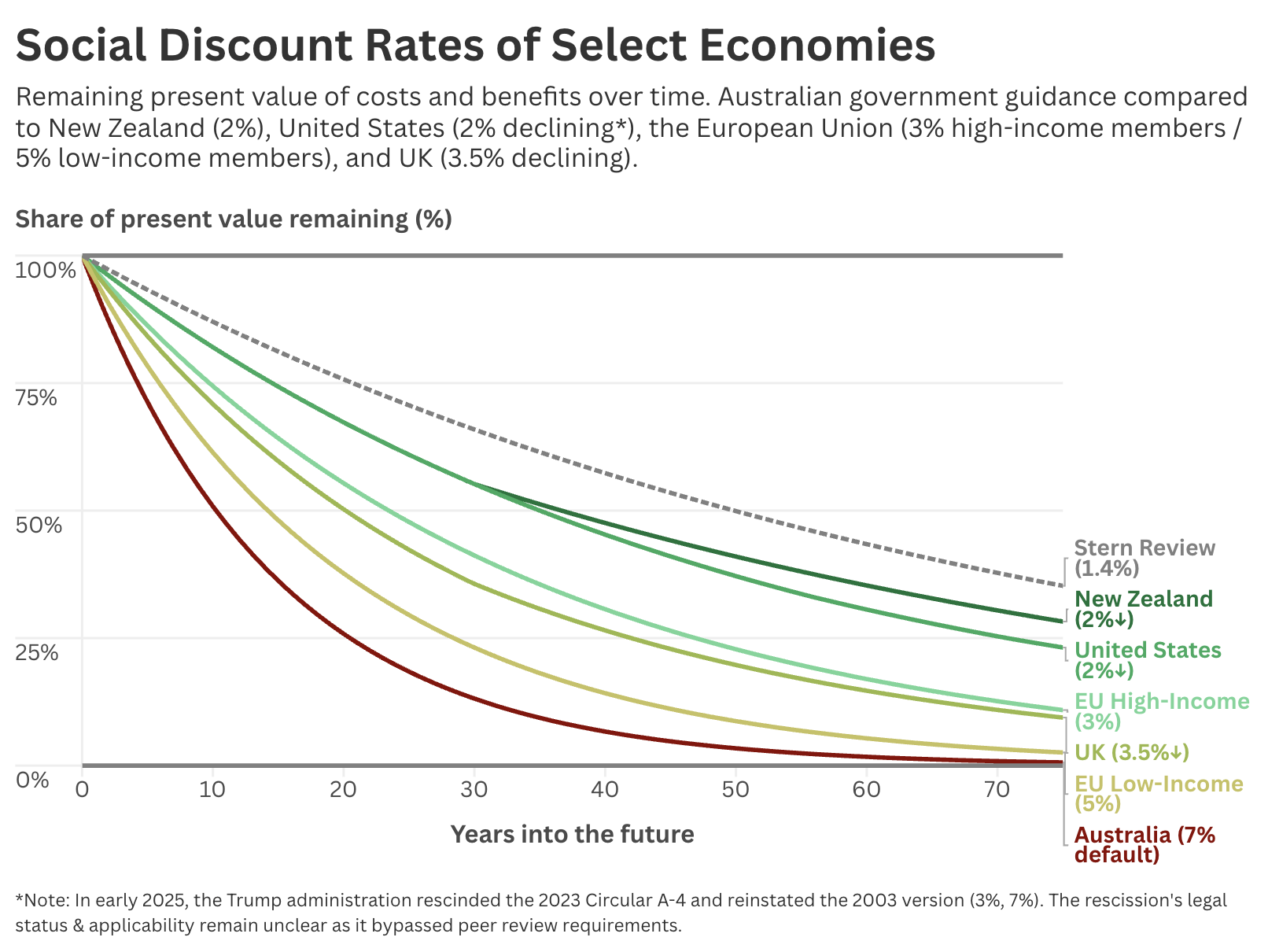
The pattern is clear: advanced economies are converging around discount rates in the 1-4% range for public policies with intergenerational impacts, recognising that higher rates systematically undervalue the welfare of future generations.
International bodies have reached similar conclusions. The IPCC consistently shows that low, declining discount rates better reflect intergenerational equity in climate analysis. The OECD warns that reliance on high discount rates undermines long-term economic performance and environmental sustainability. A 2018 survey of expert economists found that around 90% consider rates between 1-3% acceptable for long-run public projects.
Even the International Court of Justice weighed in recently, affirming in an advisory opinion that states must consider the impacts of present decisions on future generations when planning long-term policies and regulatory standards.
Embedding Short-Termism into Policy
There's also an uncomfortable disconnect between Australia's high discount rates and Indigenous principles of intergenerational stewardship. Aboriginal and Torres Strait Islander approaches to decision-making don't just acknowledge future generations – they place custodial responsibilities spanning past, present, and future at the center of how decisions are made. Country is understood as interconnected living systems requiring long-term care, with decisions evaluated based on their impacts across generations.
High discount rates do the opposite. They embed institutional short-termism into the analytical frameworks that shape regulatory policy. When a government analysis systematically values the lives today’s young people will be living 50 years from now at 3 cents on the dollar, it's not just making a technical modeling choice – it's making a moral choice about whose welfare counts.
What We're Calling For
Our submission recommends that the Office of Impact Analysis update its guidance to support lower social discount rates – centred around 1-4% – for policies and regulations with intergenerational impacts. This would particularly apply to climate policy, environmental protection, infrastructure with long lifespans, and other decisions that shape outcomes across generations.
The update should include explicit recognition that different types of policies may warrant different discount rate approaches. For short-term regulatory decisions with primarily near-term impacts, higher rates may remain appropriate. But for climate policy, environmental protection, and infrastructure that will serve communities for 50-100+ years, lower rates better reflect both economic reality and our obligations to future generations.
