
The consultancy report Woodside paid for – and what it intentionally left out

With a government decision on Browse's environmental approvals imminent, Woodside has commissioned 'big four' consultancy Deloitte to produce an economic case for the project – and is now using it as a lobbying tool.
Climate Integrity has examined the Deloitte report and found it exaggerates the project's benefits, buries its own most important figures, and ignores potentially hundreds of billions in climate costs.
We asked both Woodside and Deloitte a number of questions about their methodological choices, the omission of climate costs, and whether Deloitte's analysis was truly independent of its client's commercial interests. Both Woodside and Deloitte declined to provide a response to the questions.
Analysis by Michael Mazengarb and Kate Melville-Rea
Big Claims, Bigger Omissions
Graphic above: Extract from Woodside’s media release, following publication of the Deloitte Browse economic impact report — annotated by Climate Integrity to highlight misleading framing and omitted context.
The results of Deloitte’s “independent” analysis are being spruiked by Woodside and industry associations, and have received widespread media coverage. But a deeper examination of Deloitte’s report suggests that the rosy picture it paints of the project’s economic benefits may be too good to be true: overselling the Browse project’s benefits and ignoring its climate costs.
Climate Integrity has identified key flaws in both the economic analysis produced by Deloitte and the media statement published by Woodside, including the use of cherry-picked data to exaggerate the project’s benefits for jobs creation and tax payments.
Extraordinarily, the costs of the climate, biodiversity and environmental harms caused by the Browse project are outside the scope of Deloitte’s economic assessment. This means the economic assessment only tells half the story – overstating the project’s benefits and omitting its costs and risks.
It’s like a used car salesman touting a car’s low price, leather seats and sound system, but neglecting to mention the car needs a new gearbox.
Deloitte’s flawed gas price assumption inflates the claimed economic benefits of Woodside’s Browse Project
The most evident flaw in Deloitte’s analysis is the assumption it makes about the future price the project will receive for the gas it exports. Deloitte took a three-month average of the gas spot prices late last year and assumed this price will hold steady for the next 47 years.
This results in an assumed LNG price of US$11.5/MMBtu until 2072. This is a bold assumption - one that assumes the world will fail to act on climate change.
According to the IEA’s most recent World Energy Outlook, under a 1.5 degree of warming scenario, LNG prices in the Asian region will fall as much as 65 per cent by 2035 - falling below US$5/MMBtu and remaining at that deflated level until at least 2050. The gas price assumptions used by Deloitte are more aligned with an IEA scenario that assumes the world fails to reach net zero, and global temperatures end up on a trajectory to a dangerous 3 degrees of warming by 2100.
Deloitte’s own model claims to operate “in the context of the energy transition, where the economy is simulated to reach net zero by 2050” - yet it is using a price assumption that only makes sense if net zero never happens. It also overlooks the structural forces reshaping global gas markets, with signs that longer-term demand destruction is underway in key Asian markets, as the Iran war once again undermines the case for LNG as an affordable and secure energy source.
Deloitte’s economic justification for Browse rests almost entirely on this flawed price assumption - inflating the revenues the project would receive and in turn inflating the resulting tax payments, job creation figures and contributions to Australia’s Gross Domestic Product (GDP).
Deloitte’s headline findings, and Woodside’s media release, bury the most important figures in the fine print.
When showcasing claimed economic outcomes of the Browse project - project investment, boost to economic activity, increase in tax paid, and new jobs created - the Deloitte analysis leads with undiscounted values - leaving the most important figures, the present value amount, for the fine print.
Present value is more meaningful because it converts future dollars into today’s dollars - accounting for the fact that money received decades from now is worth less than money received today.
Guidance from both the Commonwealth Treasury and the federal infrastructure department recommends that economic forecasts discount future figures to convert amounts into "today's dollars” to allow for a fair comparison. By making the choice to headline the undiscounted figures, Deloitte is making the numbers look far more impressive than a standard economic evaluation would suggest.
Woodside adopts these figures, leading with the undiscounted figures for economic activity and tax payments, in its media statement. Woodside excluded any reference to the discounted figures, leading to a further inflated picture of the potential economic benefits of the Browse project.
-
Deloitte's report fails to consider or quantify any of the climate harms that will be caused by the project’s greenhouse gas emissions, ignoring the most critical downside of the project. Despite recognising that “broader environmental considerations are important”, Deloitte says these considerations “fall outside the scope of this assessment“ and in a guide to interpreting the report, states that it did not “assess biodiversity, or cultural heritage impacts” or “model global climate outcomes”.
If it goes ahead, Browse has the potential to produce 11.4 million tonnes of LNG, LPG and domestic gas supply annually - an extraordinary increase in gas production considering our pathway to limit warming to 1.5 degrees requires no new fossil gas development. The project’s own modelling projects up to 1.2 billion tonnes of CO2 equivalent emissions over its lifetime – rising to around 1.6 billion if a proposed life extension proceeds.
The harms these emissions cause to both humans and the environment will be material and represent material economic harms.
The growing sophistication of climate attribution science is enabling a quantification of the climate impacts attributable to individual fossil fuel projects. For example, a recent assessment of the Scarborough gas project - a smaller Woodside project, estimated to produce 876 million tonnes of CO2 over its life - published in the Nature Climate Action journal, estimated that the emissions produced over the life of that facility would be responsible for an additional 516,000 people being exposed to unprecedented heat, an additional 16 million corals lost in every bleaching event and 484 additional heat-related deaths in Europe.
By comparison, the Browse development is expected to be responsible for almost double the emissions of Scarborough.
Deloitte did not put an economic price on the damage that Browse’s emissions would cause, but established methodologies exist for doing so. Applying, for example, the US EPA's central estimate of US$190 per tonne, the extended project’s emissions carry a global damage bill of more than A$420 billion.
These estimates suggest the global climate harms attributable to the Browse gas project could be almost three-times greater than the economic benefits estimated by Deloitte, but were omitted from its report.
-
While Woodside claims the Browse project will allow gas to “[back] up renewables” and enable “a more orderly and lower-cost scale-up of renewable energy”, the report it commissioned from Deloitte says the development of the Browse gas project will delay the transition to renewable energy:
“Without the Project, declining domestic gas supply may reduce gas fired electricity generation and threaten supply security for industrial use in the 2030s. This would require rapid electrification of industrial processes and very high rates of renewable deployment to maintain reliability and meet emissions constraints.
With the Project, additional gas supply allows parts of this transition to occur later. Renewable and electrification investment is moderated in the 2030s and increased in the 2040s, while still converging on comparable levels of renewable capacity by 2050...”(p.5)
Deloitte’s report treats the delay in the transition to renewable energy as a result of the Browse project as a positive - a conclusion that can only be reached because the analysis has ignored the costs of increased greenhouse gas emissions.
-
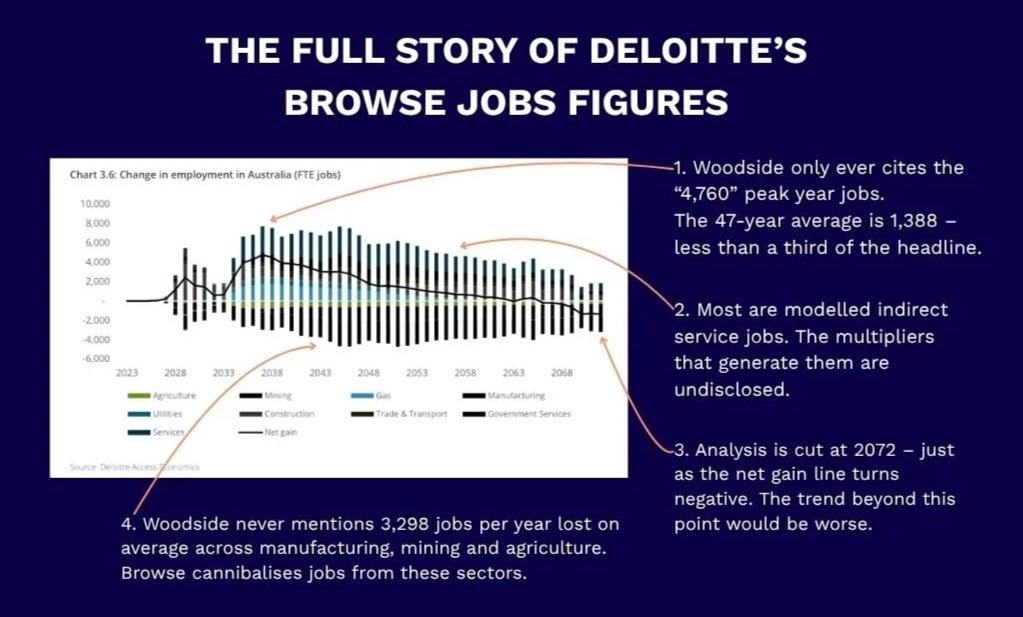
In its media release, Woodside cites Deloitte’s analysis to claim that the project will create “up to 4,760 direct and indirect full-time equivalent jobs across Australia at peak operations”.
However, the phrase “at peak operations” is doing a lot of heavy lifting. Both Woodside and Deloitte have cherry-picked the single-year employment peak in 2037 and used it in their headline figures. Yet details buried in the report shows that, on average, the number of jobs created over the full life of the project is substantially smaller.
Deloitte’s analysis estimates that, on a net basis, an average of just 1,388 full-time jobs will be created by the Browse project nationally - mostly in mining and construction. In this figure, Deloitte has also included 777 indirect "government services" jobs (in “defence, Human health and social work, Education”) - in effect taking credit for the jobs it says the Browse project would fund through the payment of taxes.
What Woodside’s statement also fails to state is that the Browse project will lead to jobs destruction in farming and manufacturing. Deloitte’s own analysis shows that the Browse project will cannibalise an average of 1,760 jobs in the manufacturing sector and 458 jobs will be lost in agriculture. Rather than supporting jobs in regional communities and the manufacturing sector, Browse instead cannibalises these jobs, leading to fewer farming jobs and a reduction in Australia’s manufacturing capabilities.

“Accepting paid commissions to produce economic modelling that supports the expansion of coal and gas, while ignoring the climate costs of doing so, is incompatible with a genuine commitment to limiting warming to 1.5 degrees.
Consultancies need to decide whether their Paris commitments are real, or just marketing.”
Executive Director, Climate Integrity
Claire Snyder
Deloitte’s “independent” analysis delivered Woodside a marketing and lobbying tool
Deloitte’s report is the latest example of a major consultancy accepting a paid commission from the fossil fuel industry which results in flawed modelling that supports a pro-gas expansion narrative. Climate Integrity has previously raised concerns about similar work undertaken by EY, ACIL Allen, KPMG and McKinsey - consultancies producing modelling that forms the basis of fossil fuel industry lobbying and advocacy.
Deloitte’s report is the latest marker of a consulting industry that is ready and willing to produce analysis for the fossil fuel industry that consistently overstates the benefits of fossil fuel expansion and ignores the mounting economic harms that fossil fuels are causing through climate change.
Deloitte Australia has set itself emissions reduction targets it says are aligned with the goals of the Paris Agreement and limiting global warming to 1.5 degrees. Deloitte’s own Net Zero Transition Plan outlines how the global consultancy plans to reduce its own emissions footprint, which it states is around 1.8 million tonnes per year.
Deloitte’s own emissions are a tiny drop in the ocean compared to Woodside’s Browse development, which could be responsible for as much as 1.6 billion tonnes of emissions over the project’s life. The fossil fuel projects that consultancies contribute to enabling through the work they undertake for clients is arguably their biggest contribution to future climate harms.
It’s not the first time that Woodside has engaged consultancies to produce modelling that inflates the claimed economic benefits of one of its prospective fossil fuel projects. As recently unpacked by Climate Integrity, Woodside commissioned consultancy ACIL Allen to produce ‘economic modelling’ of the Scarborough gas project. Again, ACIL Allen’s analysis of the Scarborough project cherry-picked job creation figures, made misleading claims about tax contributions, and ignored the costs of climate change harms.
Climate Integrity calls on consultancies and other advisory firms to ensure their work is consistent with their stated commitments to the Paris Agreement. Accepting paid commissions to produce economic modelling that supports the expansion of coal and gas – while ignoring the climate costs of doing so – is incompatible with a genuine commitment to limiting warming to 1.5 degrees and exposes the company to serious reputational risks.
As part of our analysis of the Deloitte report commissioned by Woodside, we posed the following questions to each company, to provide an opportunity to respond to our findings.
Both Woodside and Deloitte declined to provide a response to our questions.
-
Woodside’s media statement on 11 May 2026 includes the undiscounted figures, $147 billion in GDP contribution, $56.2 billion in taxes, produced by Deloitte without disclosing the present value equivalents of $33.7 billion and $13.9 billion respectively. Why were the present value figures not featured?
The IEA and IPCC project that gas demand must fall by more than 75% by 2050 to limit warming to 1.5°C. How does Woodside reconcile this with projections of stable long-term gas prices underpinning the economic case for Browse?
Deloitte's modelling uses a 3-month average over 2025 of gas prices as a proxy for prices over the next four decades. Do you consider this a robust methodology, and if so, why?
The jobs figure of "4,760 FTE jobs" in your statement represents a single-year peak in 2037. Deloitte's own modelling shows the average over the project's life is 1,388 net jobs. Why did you choose the peak figure rather than the average?
Deloitte's report does not quantify the economic cost of the project's greenhouse gas emissions, which you estimate at up to 1.6 billion tonnes over the project's life. Did Woodside instruct Deloitte to exclude climate costs from the modelling scope?
Deloitte's report explicitly states that Browse will allow parts of Australia's energy transition to "occur later," moderating renewable investment in the 2030s. Does Woodside accept this characterisation, and do you consider delaying the transition to be a benefit of the project?
-
Questions posed to Deloitte:
The report was commissioned and paid for by Woodside, and is being described as “independent” analysis. What steps did Deloitte take to ensure the analysis was conducted independently of Woodside's commercial interests?
The report leads with undiscounted figures, presenting them prominently, while often relegating discounted figures to footnotes. Why were undiscounted figures given such prominence?
Deloitte provides significant prominence to the figure of "4,760 FTE jobs" being created by the project, despite being a single-year peak in 2037. Deloitte's own modelling shows the average over the project's life is 1,388 net jobs. Why did you lead with the peak figure rather than the average?
The modelling uses a three-month average gas price held constant over approximately 40 years. What is the methodological justification for this approach, and was any scenario analysis conducted using lower future gas prices?
Deloitte’s modelling acknowledges that greenhouse gas emissions are assigned a value within the D.Climate framework, but at no point discloses what that figure. Given Deloitte's own characterisation of D.Climate as a model that 'integrat[es] economic projections with climate science to assess how emissions pathways feed back into long-term economic outcomes,' and is 'underpinned by the latest evidence in climate science', why did Deloitte omit a disclosed, quantified assessment of climate damage costs from a model it describes as climate-integrated, and was that decision made independently by Deloitte or at the direction of Woodside?"
Does Deloitte stand by the report's framing of a delayed renewable energy transition as an economic positive, given that this conclusion is only reachable if long-term global climate costs are excluded from the analysis?
You describe 7% per annum as a 'social discount rate' when presenting present value figures. Who specifically decided that 7% was the appropriate social discount rate for this assessment, and on what published methodological basis?
Australia's Safeguard Mechanism is not mentioned once across your entire report. This is a material omission, as Safeguard Mechanism compliance costs and declining baselines could significantly affect the project's financial and emissions profile over its operational life. Was the Safeguard Mechanism included in the modelling in any form, and if not, was its omission a decision made by Deloitte independently or at the direction of Woodside?
The projected emissions footprint of the Browse project is significant, estimated to reach up to 1.6 billion tonnes over the life of the project. Does Deloitte consider the future climate impact of the projects it accepts, and does Deloitte measure its ‘serviced emissions’ – the emissions arising from or impacted by client activities that are informed or enabled by the advice or services of a professional service provider?