
What we told the Climate Change Authority about Australia's progress
Climate Integrity has made a submission to the Climate Change Authority on its preparation of the 2026 Annual Progress Advice.
We set out why Australia is off track against both its 2030 and 2035 emissions reduction targets, how contradictory federal policy signals are undermining the country's primary emissions reduction policy, and what reform of the Safeguard Mechanism would need to deliver to close the gap.
1. Australia is off track, and undercutting its own policies
Australia is at a critical moment in its energy transition.
In assessing Australia's progress towards its emissions reduction targets, we note that Australia is a signatory to the United Nations Framework Convention on Climate Change and the treaties that have been developed under that framework – including the Paris Agreement.
The Paris Agreement requires parties, including Australia, to make best efforts to limit global warming to well below 2°C above pre-industrial levels, and to actively pursue efforts to limit the increase to 1.5°C. Parties also agreed to achieve net zero emissions by the second half of the century, with Australia adopting a net zero by 2050 target for this purpose.
In response, Australia has committed to an emissions reduction target range of 62 to 70 per cent by 2035, which is the target range advised by the Climate Change Authority. To align with the goals of the Paris Agreement, Australia must at a minimum meet the upper ambition of this target.
Despite the Authority providing a blueprint for how Australia can decarbonise and build a sustainable and economically resilient economy, Australia is currently off track to deliver its 2030 emissions reduction target of a 43 per cent reduction below 2005 levels, and very far off track to meet its 2035 target. The Authority's own 2025 report found that for Australia to meet its 2030 target, emissions reductions would need to more than double from current trajectories. For the 2035 target to be met, those cuts would need to more than triple.
Australia's primary emissions reduction policy, the Safeguard Mechanism, covers approximately 30 per cent of Australia's total greenhouse gas emissions. It should be playing an outsized role in meeting Australia's legislated targets. However, in 2024–25, aggregate onsite emissions from the country's biggest industrial emitters dropped by just 2.3 per cent. The use of offsets has also increased dramatically, up by 49 per cent compared to 2023–24, as facilities preferred cheap offsets over meaningful emission reductions onsite. The case for significant reform of the Safeguard Mechanism is strong.
However, even if the Safeguard Mechanism is reformed and strengthened significantly, it would continue to be undermined by an even stronger price signal. Every year, the Australian Government hands billions of dollars to the country's largest mining companies through the Fuel Tax Credit scheme – a subsidy for diesel use – while simultaneously charging those same companies for their emissions under the Safeguard Mechanism. The result: two federal policies working in direct opposition, with one wiping out the other.
Similarly, the decarbonisation signal intended by Future Made in Australia – the government's flagship industry policy for building a low-carbon manufacturing base – is consistently drowned out by approvals of new fossil fuel export projects. Australia is the third largest exporter of fossil fuels globally. It can't both advance a green exports vision and maintain and expand its role as a major fossil fuel exporter. Every new coal and gas project waved through adds to the very emissions burden the Safeguard Mechanism is meant to be driving down. This renders the task of the Safeguard Mechanism harder and delays a fair and just transition.
While we have seen glimmers of bright spots in Australia's decarbonisation journey in the past year – in particular, Australia is pioneering a revolution in home renewables and battery use that has transformed the power grid – Australia is otherwise pulling in two directions at once, undercutting its own emissions reduction policies with contradictory support for expanded fossil fuel production and use. These conflicting signals undermine the certainty and credibility Australia needs as a trade and investment partner, and risk a disorderly transition.
Ultimately, it is people and communities who will bear the brunt of the risks and costs if the transition is not properly managed. The Australian Government must act quickly to set the conditions for a prosperous, resilient net zero future.
2. Fuel tax credits are muting the Safeguard Mechanism's price signal
One of the largest impediments to Australia achieving its emissions reduction goals is contradictory policy signals that work to simultaneously incentivise and disincentivise the consumption of fossil fuels.
The current structure of the Fuel Tax Credit scheme is undermining the Safeguard Mechanism and acting as a major impediment to Australia's emissions reduction goals. Working towards a winding back and eventual phase-out of the scheme would provide an immediate additional lever to incentivise decarbonisation and electrification, particularly among major resources companies. Winding back the scheme would also bolster the Federal Budget, providing critical resources that can be used towards supporting small operators, farmers, and communities impacted by the effects of worsening climate change.
Despite the Australian Government committing to reduce greenhouse gas emissions, emissions from Australia's transport sector have remained stubbornly high. The primary driver of increased growth in transport emissions has been growth in the use of light commercial and heavy vehicles in commercial and industrial sectors, including mining, logistics, heavy road transport and construction – which primarily use diesel fuels.
Broadly, fuel consumption across these sectors is effectively not subject to the federal fuel excise, as those sectors receive full or partial refunds of excise paid through the Fuel Tax Credit scheme. Analysis of trends in Australian transport emissions and the sectors driving sustained growth in greenhouse gas emissions demonstrates a clear relationship: transport sectors that enjoy exemptions from the federal fuel excise are the same sectors experiencing the greatest growth in fuel consumption and subsequent emissions.
Between 2014–15 and 2022–23, the mining sector was responsible for the largest gross increase in liquid fuel use across all commercial and industrial sectors. Over the same period the mining sector was, by far, the largest recipient of fuel tax credits, receiving an aggregated $26.9 billion in fuel tax credits.
A relatively small number of multinational mining companies receive a disproportionate share of the scheme. In FY2025, 18 major diesel consumers received refunds of $3.36 billion. Australia's five biggest mining companies – BHP, Rio Tinto, Glencore, Fortescue, and Yancoal – collectively received $1.94 billion in refunds in 2025.
Analysis by Naru Research, commissioned by Climate Integrity, shows that while the top 18 recipients of the Fuel Tax Credit in FY2025 received $3.36 billion, their effective cost of compliance under the Safeguard Mechanism was just $150 million. This represents a ratio of 22 to 1 between the aggregate fossil fuel rebate received and the costs of compliance under the Safeguard Mechanism.
Australia's industrial emitters are receiving conflicting policy signals. The Safeguard Mechanism is supposed to signal that emissions are costly and must come down. The Fuel Tax Credit scheme tells the same companies, at the same facilities, that the costs of the diesel behind those emissions are subsidised by the Commonwealth. The price signal of the Safeguard Mechanism is being muted.
Reform to the scheme for its major recipients – which could include capping and reinvesting or diverting funds – would provide a powerful incentive for the biggest miners, which have the balance sheets and the technology, to lead the transition off diesel and invest in the electrification of their operations.
3. Our top priorities for climate policy reform
Stopping approvals of new and expanded fossil fuel production
The urgency of the climate crisis requires an immediate end to approvals for new fossil fuel projects in Australia, consistent with the guidance from major institutions on the measures necessary to achieve the goals of the Paris Agreement and to limit global warming to 1.5 degrees.
In July 2025, the International Court of Justice published an advisory opinion on the Obligations of States in respect of Climate Change. The advisory opinion was authored by 15 members of the Court and represented the unanimous views of those member judges.
In this advisory opinion, the Court found that under customary international law, all States have an ‘obligation to prevent significant harm to the climate system and other parts of the environment’, and that to discharge this obligation, States must implement ‘regulatory mitigation mechanisms that are designed to achieve the deep, rapid, and sustained reductions of GHG emissions that are necessary for the prevention of significant harm to the climate system’.
The Court expressed an expectation that necessary actions include the regulation of both public and private operators. Further, the Court warned:
Failure of a State to take appropriate action to protect the climate system from GHG emissions — including through fossil fuel production, fossil fuel consumption, the granting of fossil fuel exploration licences or the provision of fossil fuel subsidies — may constitute an internationally wrongful act which is attributable to that State.
The Court further warns that breaches of States’ obligations to prevent significant harm to the climate system:
may give rise to the entire panoply of legal consequences provided for under the law of State responsibility. These include obligations of cessation and non-repetition, which are consequences that apply irrespective of the existence of harm, as well as the consequences requiring full reparation, including restitution, compensation and/or satisfaction.
To avoid further legal liabilities under international law, Australia must take measures to prevent the expansion of fossil fuel production.
Eliminating fossil fuel subsidies
In addition to ceasing the expansion of fossil fuel production, to comply with international law, Australia must act to phase out fossil fuel subsidies.
During the COP30 climate negotiations in late 2025, Australia became a signatory to the Belém Declaration to Transition from Fossil Fuels. Through the declaration, signatories recognised ‘the need to phase-out inefficient fossil fuel subsidies as soon as possible’. As the President of Negotiations for COP31, Australia has a responsibility to demonstrate leadership in tackling the issue of fossil fuel subsidies.
Climate Integrity recommends that the Australian Government plan to phase out all sources of fossil fuel subsidy over time, prioritising the largest industrial users immediately – primarily large mining companies – while providing appropriate support for small business, farmers and other industries to transition away from the Fuel Tax Credit scheme, an effective fossil fuel subsidy provided primarily to emissions-intensive industries.
Achieving a just transition that is fair for workers and communities
The rising costs of climate impacts will leave a growing number of communities financially vulnerable, with a growing number of households and businesses becoming uninsurable and recovery costs becoming unsustainable, shifting the cost burden onto governments. As the first National Climate Risk Assessment warned, ‘climate-related disasters will add fiscal pressure to government budgets’, and funding provided under Disaster Recovery Funding Arrangements could increase by as much as 600 per cent under a +3°C of global warming scenario.
Climate policy must work to protect the most vulnerable and impacted communities from the harms of climate change, while also ensuring workers potentially impacted by the closure of industries – necessary as part of a transition to a decarbonised economy – are supported to benefit from the opportunities that same transition will create in future industries.
4. The Safeguard Mechanism is not driving onsite abatement
The extent of onsite abatement can be readily assessed with reference to the proportion of reductions in covered emissions that can be attributed to real-world reductions in facility emissions, compared to the proportion of emissions reductions achieved through the surrender of Australian Carbon Credit Units (ACCUs) or Safeguard Mechanism Credits (SMCs).
The 2024–25 Safeguard Mechanism data insights published by the Clean Energy Regulator show that despite aggregated baselines falling by 9.9 million tonnes in 2024–25, total covered emissions fell by just 3.2 million tonnes. A majority of facilities in 2024–25 – 141 out of 208 – reported gross covered emissions in excess of their annual baselines, with a total scheme-wide excess of 13.7 million tonnes. This contributed to substantial use of ACCUs and SMCs, with 13.4 million units surrendered to achieve compliance.
Comparing the actual reduction in covered emissions of 3.2 million tonnes with the volume of credit surrenders of 13.4 million highlights the extent to which very little onsite abatement was achieved under the Safeguard Mechanism in 2024–25. Similar analysis can be undertaken in future years.
Reference to external information would provide further context to assessments of whether the Safeguard Mechanism is supporting investment in onsite abatement actions. Tracking announcements of commitments or final investment decisions in abatement activities would provide potentially useful information regarding whether the scheme is supporting longer-term and systemic investments. However, reviews of company announcements show very little commitment to onsite abatement, with some of the scheme's largest emitters delaying or cancelling previously announced plans to invest in the decarbonisation of their emissions.
There is little evidence of facilities announcing long-term investments in onsite emissions reductions, and analysis of the early years of the reformed Safeguard Mechanism suggests that compliance is overwhelmingly being achieved through the surrender of carbon credits. The widespread availability of cheap offsets blunts the drive to reduce emissions onsite, and stymies the case for investing in long-term systemic emissions abatement.
5. The Safeguard Mechanism should be strengthened to do more of the task
Decline rates should be calibrated to the top of the 2035 target range
The Safeguard Mechanism represents Australia's most direct policy measure for driving reductions in greenhouse gas emissions, and by design covers industries that are best placed to deliver deeper and long-term reductions compared to other parts of the economy. As such, it should deliver a fair share of the nation's total emissions reduction task, and this requires the Safeguard Mechanism to deliver a greater-than-proportional share of Australia's 2030 and 2035 emissions reduction targets.
Decline rates for covered facilities should be calibrated with reference to the higher end of Australia's 2035 emissions reduction target, being 70 per cent below 2005 levels by 2035. Achieving alignment with the higher end of the target range will provide greater certainty that Australia can achieve the 2035 target. If the decline rates were set with reference to the lower end of the range, policy underperformance risks Australia failing to achieve the target. Given the low probability that other sectors will deliver more than their share, setting the target with reference to the lower end of the 2035 target range would represent a repudiation of the higher end of Australia's climate target less than twelve months after that target was set.
With reference to the existing 2023 baseline year for Safeguard Mechanism decline rates, adjusted decline rates of 7% to 7.5% for the period between 2030 and 2035 are necessary to align with the 70 per cent by 2035 target. The current post-2030 decline rate of 3.285 per cent is less than half the rate required to align with the 70 per cent by 2035 target.This should serve as a floor for decline rates under an updated Safeguard Mechanism, with facilities operating in emissions-intensive sectors, like fossil fuel production facilities, allocated higher decline rates.
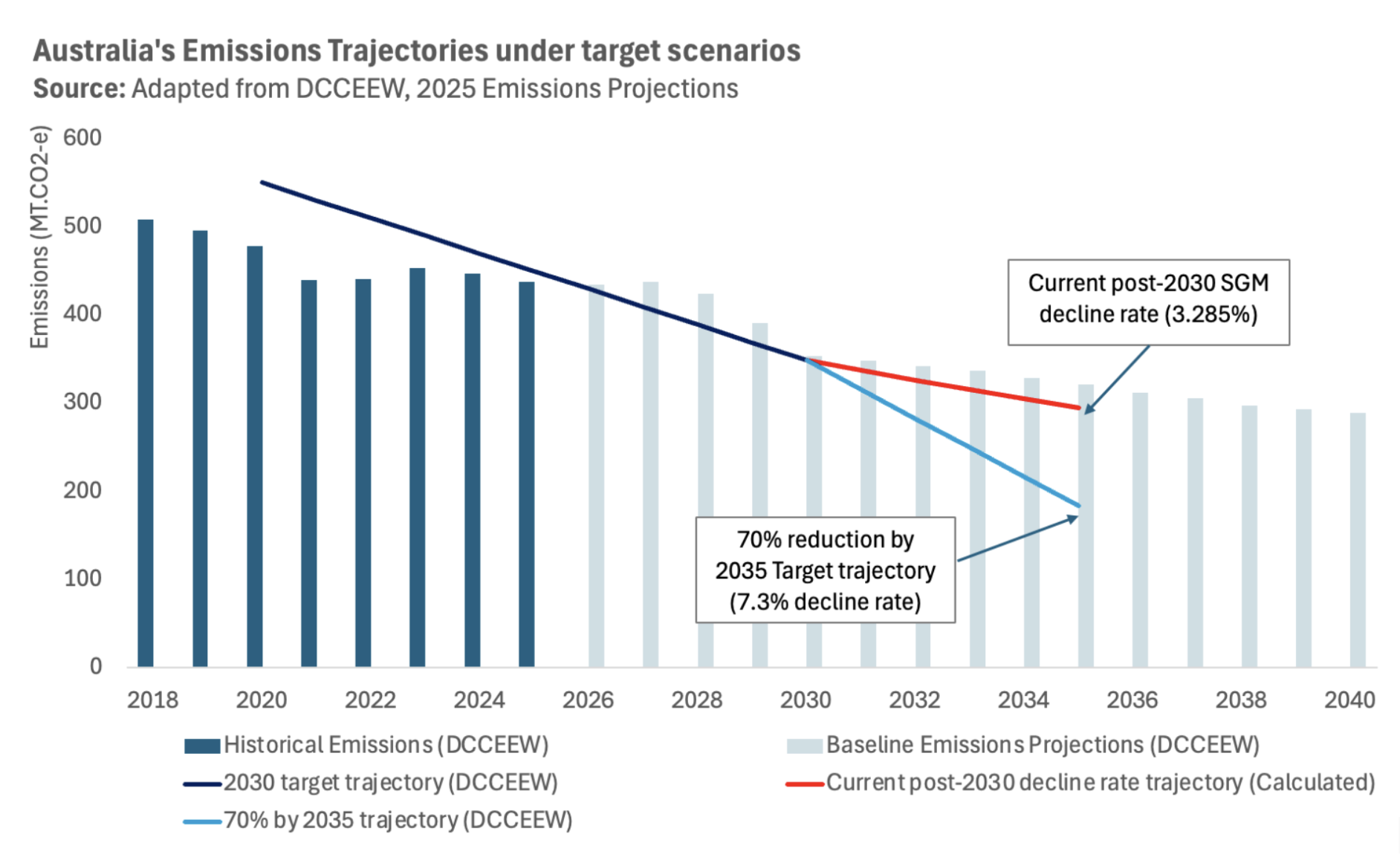
The current post-2030 decline rate of 3.285 per cent is less than half the rate required to align with the 70 per cent by 2035 target.
Differentiated decline rates for fossil fuel production facilities
Differential treatment of facilities is an established feature of the Safeguard Mechanism.
Under the existing National Greenhouse and Energy Reporting (Safeguard Mechanism) Rule 2015, there is already differentiation between facilities with regards to baseline arrangements, beyond the different treatment that applies to trade exposed, baseline adjusted facilities. For example, section 10(2) of the Rules establishes a special rule for shale gas extraction facilities that mandates a zero baseline. Coal mines currently receive favourable treatment through a delayed transition to industry-average baseline determinations.
In recognition of the outsized role that fossil fuel industries have played in contributing to higher domestic greenhouse gas emissions as well as increases in global emissions, it is justifiable and consistent with the principles of the Rules for a differentiated approach to baseline setting to apply.
Differentiation in the baseline setting for fossil fuel production facilities, which imposes stricter decline rates to accelerate emissions reductions, would support the achievement of Australia's greenhouse gas reduction target and Australia's commitments to the phase-out of fossil fuels. It would support the Safeguard Mechanism to achieve an outsized contribution to Australia's overall emissions reduction task, without increasing the burden on other sectors.
Limits on the use of carbon credits
The current design of the Safeguard Mechanism permits unlimited use of ACCUs and SMCs to achieve compliance under the scheme. As detailed above, this has contributed to a lack of investment in onsite abatement.
Under its current design, the volume of ACCU and SMC surrenders can proportionally increase as a facility's baselines decline. There are no limits on their use, and this allows facilities to maintain compliance under the Safeguard Mechanism potentially without making any progress towards reducing onsite emissions, and while increasing gross emissions. This is reflective of the trends already observed in the outcomes of the early years of the reformed scheme.
While the Safeguard Mechanism requires covered entities to provide a report to the Clean Energy Regulator when their use of ACCUs or SMCs exceeds 30 per cent of their baseline, these statements have not compelled entities to achieve onsite abatement. The purpose of the statement is to explain why there had not been more onsite abatement at the facility during the compliance period. However, there are no accountability mechanisms relating to these statements, and in practice they have offered very little in terms of incentive to achieve onsite abatement.
The design of the Safeguard Mechanism must be further evolved into a fully-fledged policy for driving systemic emissions reductions. This will require limits to be imposed on the use of credits under the scheme. Enforceable limits on credit use, through the introduction of a supplementarity limit, would compel covered facilities to achieve onsite abatement. Such limits could restrict the quantity of ACCUs and SMCs that a covered facility surrenders in a compliance year, as a proportion of a facility's covered emissions.
Limits on the use of ACCUs may be applied differently across sectors, reflecting their underlying challenges to abatement, the availability of emissions reduction technologies or alternatives, and broad public interest considerations. Sectors with demonstrated ability to achieve significant onsite abatement at low cost may be allocated stricter limits. Consistent with the justifications for differential treatment in baseline decline rates for fossil fuel producers, stricter limits on ACCU and SMC use should apply to fossil fuel producers, to drive more systemic reductions in emissions-intensive industries.
Carbon removals play a crucial role in the transition to net zero, but land-based carbon removal is limited by sustainability constraints that are frequently ignored in the current Australian policy landscape. Setting a sustainable national carbon removals budget and principles for how carbon removals are used could manage land-use trade-offs and inform an appropriate cap on ACCU use in the Safeguard Mechanism. Climate change demands that we reframe the limited resource of carbon removals as a common good and allocate them to industries with the highest social value.
The Australian Government should also provide a clear signal that the use of international carbon credits will not be permitted under the Safeguard Mechanism. The potential prospect of access to lower-cost, and often low integrity, international units works to stymie investment in onsite abatement, and a definitive statement ruling out their availability is warranted.
Our recommendations
Safeguard Mechanism decline rates should be calibrated to the upper end of the 2035 target range, with adjusted rates of 7% to 7.5% between 2030 and 2035 serving as a floor, so that the scheme delivers a greater-than-proportional share of Australia's emissions reduction task.
Fossil fuel production facilities should be allocated stricter decline rates and stricter limits on credit use, consistent with the differential treatment already established under the Safeguard Mechanism Rules.
Enforceable limits should be placed on the use of ACCUs and SMCs, through the introduction of a supplementarity limit, with an appropriate cap on ACCU use informed by a sustainable national carbon removals budget and principles for how carbon removals are used. The Australian Government should also rule out the use of international carbon credits under the scheme.
The Fuel Tax Credit scheme should be wound back for its largest recipients and eventually phased out, as part of a plan to phase out all fossil fuel subsidies over time, with appropriate support provided for small business, farmers and other affected industries.
Approvals of new and expanded fossil fuel production should end, consistent with the International Court of Justice's clarification of States' obligations to prevent significant harm to the climate system.
Australia is otherwise pulling in two directions at once, undercutting its own emissions reduction policies with contradictory support for expanded fossil fuel production and use. It is people and communities who will bear the brunt of the risks and costs if the transition is not properly managed.
