
This week the NT Government has been spruiking the first gas flows coming from fracking in the Beetaloo Basin – claiming that development of the Beetaloo is “forecast to generate more than $17 billion in economic value over the next two decades and support more than 13,000 jobs by 2040”. But a closer look at the numbers reveals they are cherry-picked and misconstrued from a nine-year-old report.
As fracked gas sales from the Beetaloo Basin flowing into the Northern Territory power grid are imminent, Chief Minister Lia Finocchiaro and Deputy Chief Minister Gerard Maley this week issued a media release claiming development of the basin "is forecast to generate more than $17 billion in economic value over the next two decades and support more than 13,000 jobs by 2040." The claim has been repeated in some media reporting.
These numbers come from a 2017 economic assessment by consultancy ACIL Allen, prepared for the NT Government’s Scientific Inquiry into Hydraulic Fracturing (Pepper Inquiry).
Aside from the issue of using a nine-year-old report to source their claims, there a number of other problems with the way the NT government has used the numbers:
Both the jobs figure and the economic value figure trace back to a single scenario from the report – a scenario that ACIL Allen rates as a “very low” probability of occurring. If the government had used the scenario which ACIL Allen said was more likely, the economic value drops from $17 bn to $5.1 bn.
The $17 billion figure taken from the ACIL Allen report refers to “real output”: the total value of everything produced. Using “real income” – which ACIL Allen describes as a “measure of the welfare of residents in the economy” – and using a more likely scenario, the figure drops to less than one billion dollars (or $147 per capita, per annum over the modelling period).
These figures neglect to include the environmental, health and amenity costs of fracking.
The headline figure used by the NT government of 13,000 jobs is a count of job-years, not jobs. This makes the employment wins seem bigger than they are. “Jobs” counts actual positions, while “job-years” is a unit measuring one full-time job for one year. The annual number of jobs the report says Beetaloo development could create – even under the “very low” probability scenario – is just 524. Under a “moderate probability" scenario it is 82 jobs per year, with all new jobs coming at the cost of jobs elsewhere in Australia.
There is also the issue of what the NT government leaves out. The media release describes the Beetaloo as "one of the world's most significant onshore gas reserves, containing an estimated 430 trillion cubic feet of gas in place, enough to meet Australian gas demand for 200 years."
While the commercial viability of extracting all this gas is highly doubtful, if it was, it would release approximately 23 billion tonnes of CO₂ – more than 50 years of Australia's entire annual emissions, and roughly a sixth of the world's remaining carbon budget for limiting warming to 1.5 degrees. Priced at the US EPA's central estimate of the social cost of carbon, the climate damage would be in the order of US$5 trillion – dwarfing any conceivable economic benefit to the Territory.
Claire Snyder, Executive Director of Climate Integrity, says:
"The Territory Government is quoting the fantasy version of a nine-year old report. Fracking the Beetaloo Basin at the scale these numbers suggest is not commercially viable - even if the gas industry keeps getting propped up with taxpayer money. Territorians deserve to make decisions about their land, water and economy based on what the evidence actually says."
How the NT Government inflated the numbers
To see why the NT government’s numbers don’t stack up, we first need to understand what the underlying modelling actually measured.
ACIL Allen modelled five scenarios over a period running from 2018 to 2043:
Baseline: moratorium on fracking stays.
CALM: exploration goes ahead but the resource proves non-commercial and operators walk away.
BREEZE (100 terajoules of gas a day),
WIND (400 TJ/day)
GALE (1,000 TJ/day).
The government's headline figures – “$17 billion” and “13,000 jobs” – were then assembled in three steps. Each step moved the number further from what the report actually says:
First, the NT government reached for the unrealistic GALE scenario, which assumes 1,000 terajoules of gas a day. Tamboran’s company announcement says its new facility can facilitate just five per cent of that: “up to 50 TJ/d”. Production would have to double again just to reach the 100TJ/d “Breeze” scenario, let alone GALE. GALE also assumes much more than volume – it has the Amadeus, Northern Gas and Carpentaria pipelines all expanded, plus a new 550-kilometre pipeline to feed Darwin LNG.
Second, they added up the years. GALE's 13,611 is a count of job-years, not jobs, accumulated across ACIL Allen's whole 2018–2043 modelling period. Twelve of those 25 years cannot deliver a job to anyone: nine have already elapsed, and three fall after the government's own cut-off of "by 2040". Annually, ACIL Allen estimates an average of "82 FTE (BREEZE), 252 FTE (WIND) and 524 FTE (GALE)". Even taking the government's chosen GALE scenario at face value, "13,000 jobs" becomes 524 a year, one twenty-fifth of the headline. The $17 billion was built the same way, totalling 25 years of activity into a single figure.
Third, they called an unlikely result a "forecast". ACIL Allen rated GALE "very low" probability, and rated failure to commercialise (exploration going ahead and operators walking away) "very high". A forecast implies the most likely outcome. The NT Government’s assumption is the least likely one.
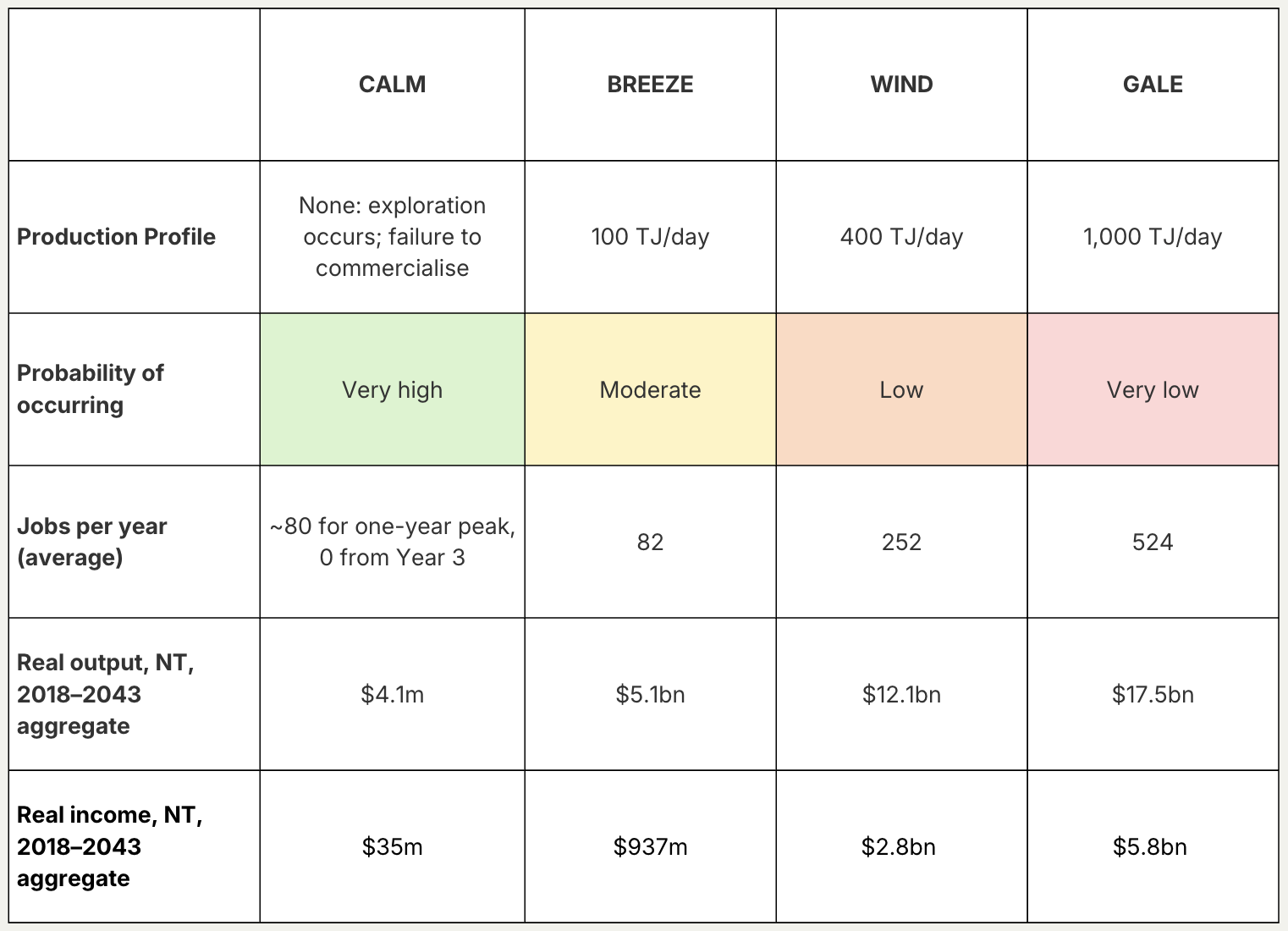
Above: Key statistics pulled from ACIL Allen (2017), The Economic Impacts of a Potential Shale Gas Development in the Northern Territory
"200 years of gas": the claim behind the claim
The media release also describes the Beetaloo as: "one of the world's most significant onshore gas reserves, containing an estimated 430 trillion cubic feet of gas in place, enough to meet Australian gas demand for 200 years."
Gas "in place" is not gas that can be extracted for use. But suppose – as the government implicitly assumes – it could be: If all this gas were extracted and burned, it would release approximately 23 billion tonnes of CO₂ – more than 50 years of Australia's entire annual emissions, and roughly a sixth of the world's remaining carbon budget for limiting warming to 1.5 degrees. Priced at the US EPA's central estimate of the social cost of carbon, the climate damage would be in the order of US$5 trillion – dwarfing any conceivable economic benefit to the Territory.
Background
We have previously raised concerns about how commissioned economic modelling is used to inflate the case for fossil fuel projects, including reports by Deloitte, EY, ACIL Allen, KPMG and McKinsey. The ACIL Allen modelling has its own problems: it explicitly excludes environmental, health and amenity costs as outside its terms of reference, so not a dollar of the climate damage above appears anywhere in the $17 billion headline figure, and ACIL Allen itself told readers to treat its results with higher than usual caution. However, what we are more concerned about is the government’s representation of it. We call on the NT Government to correct the public record, and on media outlets to check headline claims against the reports they cite.
Notes and Methodology
Emissions from 430 tcf: combustion-only estimate 54.81 kg CO₂ per thousand cubic feet of natural gas (EIA, 2024): 430 trillion cubic feet ≈ 23.6 Gt CO₂. Excludes upstream methane leakage and processing emissions, which would increase the total. Australia's annual emissions = 455.6 Mt CO₂-e (DCCEEW, March 2026). Remaining carbon budget for a 50% chance of limiting warming to 1.5°C ≈ 130 Gt CO₂ from the start of 2026 (Forster et al., 2026); 23.6 Gt is approximately 18% of this budget. Social cost of carbon: central 2026 estimate of US$215/t CO₂ (US EPA, 2023) × 23.6 Gt = US$5.07 trillion in 2020 dollars.
ACIL Allen rated GALE as “very low” under a partial lift of the moratorium because there is less scope to find the most commercial deposits. The NT Government lifted the moratorium in April 2018 subject to no-go zones covering 49 per cent of the Territory – a partial lift.
Questions posed by Climate Integrity to the NT Government:
1. Has Tamboran’s gas started to be sent into the grid? The Tamboran ASX announcement on the 2nd of September said first gas sales were imminent.
2. If not, when is the first gas expected to be sold by Tamboran to the NT Government into the energy grid?
3. Your release states the development "is forecast to generate more than $17 billion in economic value over the next two decades and support more than 13,000 jobs by 2040". ACIL Allen's 13,611 is a job-years total accumulated over 25 years, not a number of jobs. Will you correct the claim?
4. On what basis did the Government select the GALE scenario figures for this release, given up to 40 terajoules a day is set to flow, as compared to GALE's assumed 1,000?
5. ACIL Allen excluded environmental, health and climate costs as outside its terms of reference. What is the Government's estimate of the climate cost of Beetaloo development?
6.. ACIL Allen states its modelling is not an assessment of commercial viability, and rates failure to commercialise as "very high". On what basis is it described as a "forecast"?
7. Where did “by 2040” come from in the ACIL Allen report?
The NT government response:
A Government spokesperson said:
‘The Government stands by the report and looks forward to future generations of Territorians benefitting from the transformational positive economic and employment outcomes delivered by the Beetaloo Sub-basin.’
