
If you live in Australia and are on social media, you’ve likely seen the ads. Since May, the gas lobby group, Australian Energy Producers (AEP), has been spending thousands of dollars a day on Facebook and Instagram promoting the “jobs” and “economic benefits” of the gas industry. Together, these ads have been shown at least 53 million times.
The fossil fuel industry always spends big to protect its image, so it’s little surprise the gas lobby thinks it needs a polish now. This year alone, a Senate inquiry has heard evidence that Australians are being short-changed on gas industry tax, there’s been renewed scrutiny of how gas exports have driven up prices at home, and the climate impacts of burning gas are becoming harder to ignore as we head into an El Niño.
The problem is, the figures being used to sell this economic “success story” are entirely hypothetical. They come from a problematic 2024 KPMG report the AEP commissioned. It modelled an Australia that suddenly stopped producing gas, then assumed nothing would adapt. Those stacked, theoretical losses were then rebranded as the industry's "contribution".
When a consultancy lends its name to modelling like this, the cost is not only a slower and more expensive energy transition. It is the credibility of the professional advice the rest of the economy has to trust.
Since 14 May 2026, Australian Energy Producers (AEP), the peak body for Australia's oil and gas industry, has been running a steady stream of Facebook and Instagram ads citing KPMG figures on the gas industry's jobs and economic contribution.
By 7 October, AEP had run more than 390 ad postings carrying these claims, with at least $330,000 in disclosed spend and possibly more than $430,000. That's an average of around $2,250 a day for almost five months. Spending surged in the fortnight from 20 July to about $6,700 a day, triple the launch rate. More than 50 of the ads were still running on 7 October.
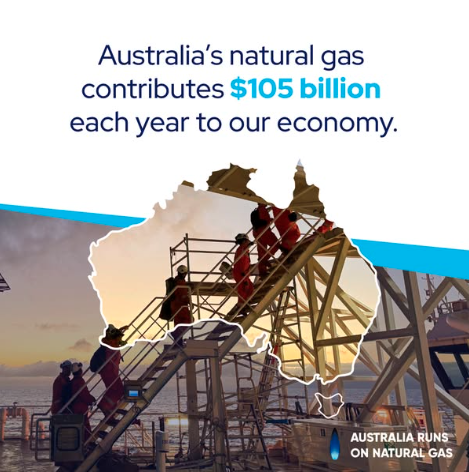
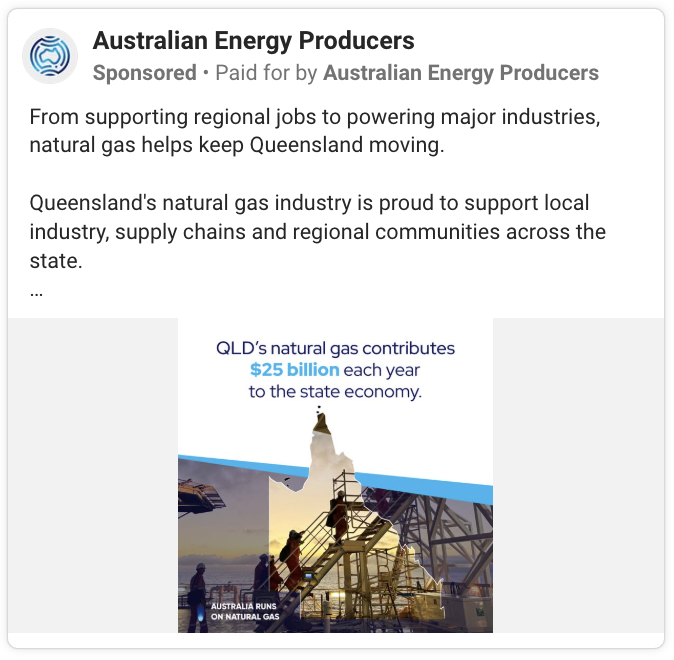
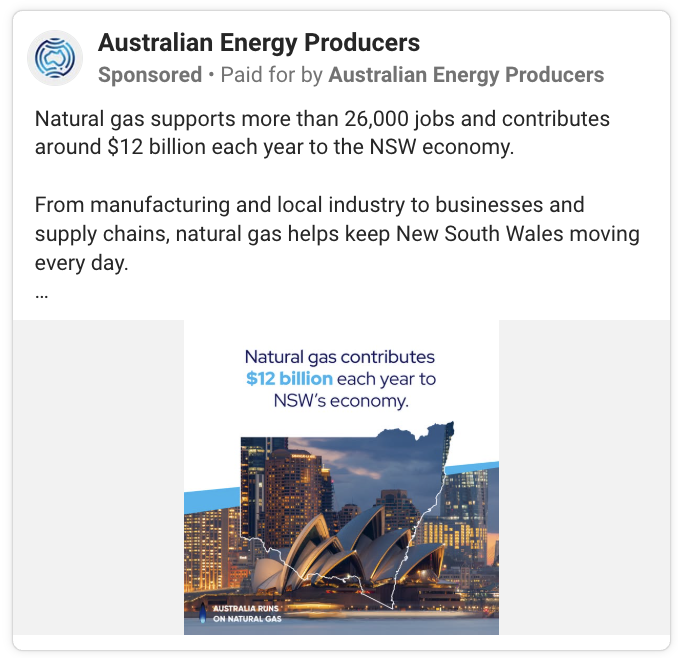
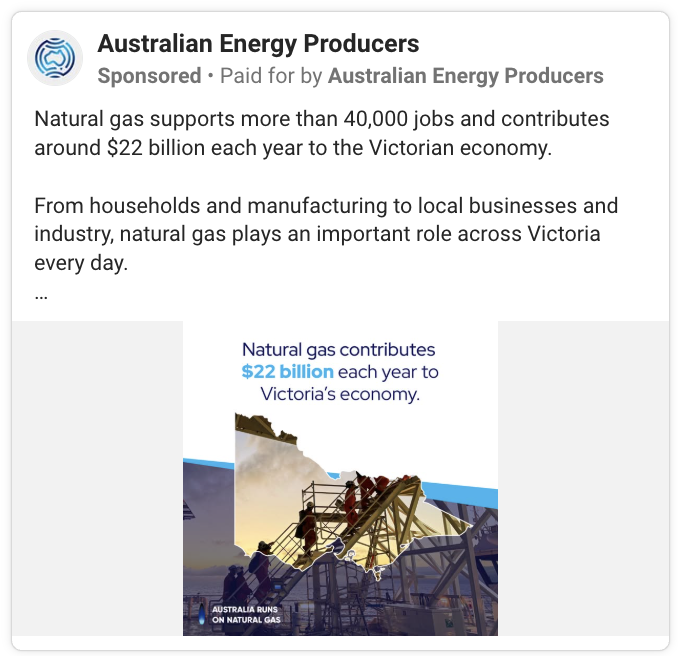
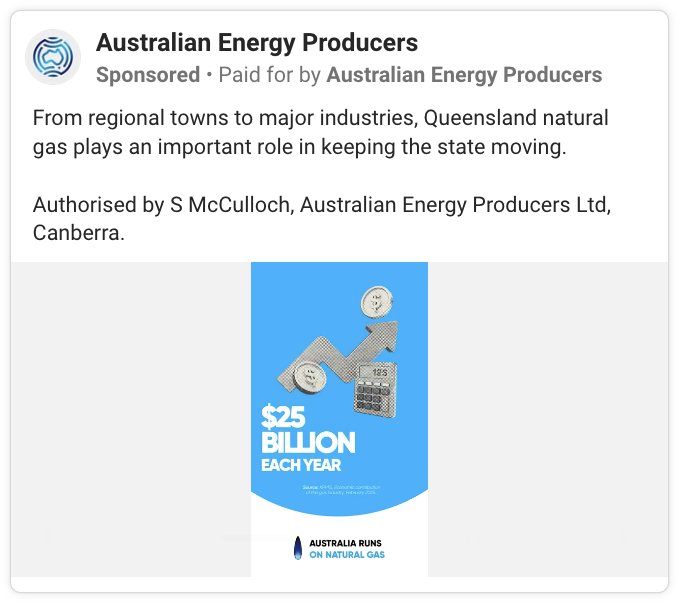
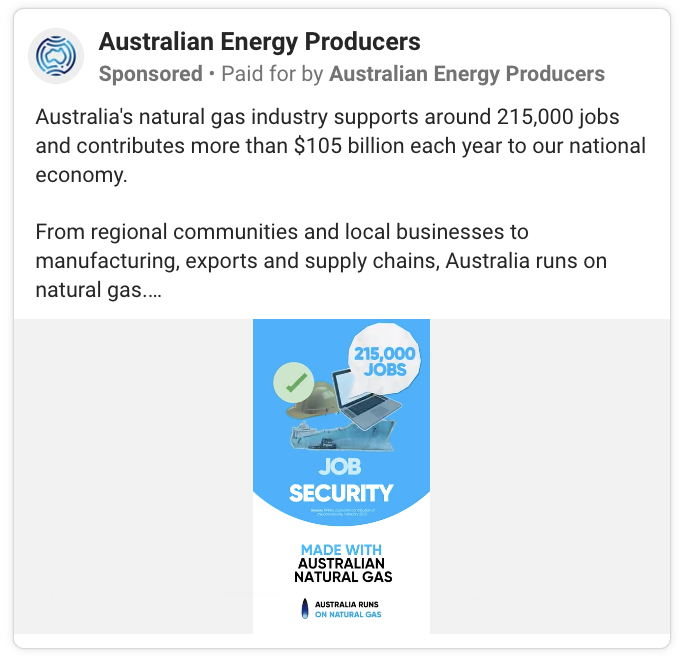
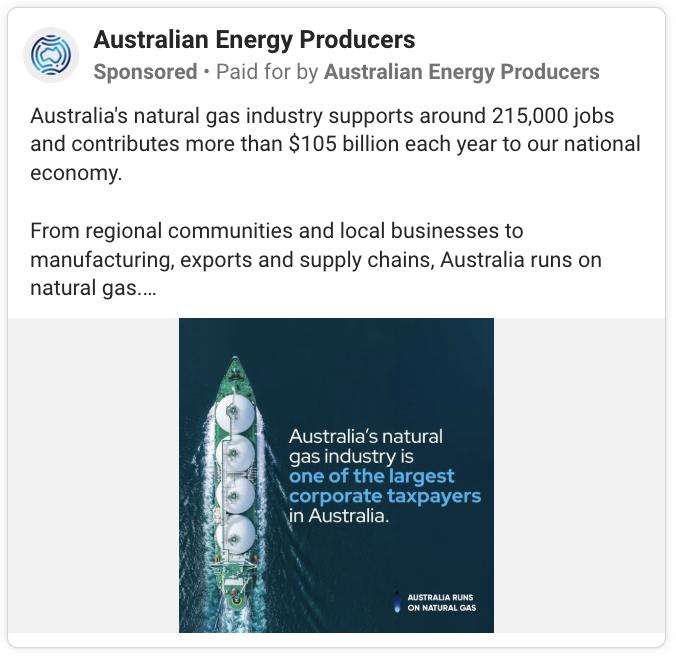
active ads by gas lobby, Australian Energy Producers, as of 13 Oct 2026.
Source: Meta Ad Library
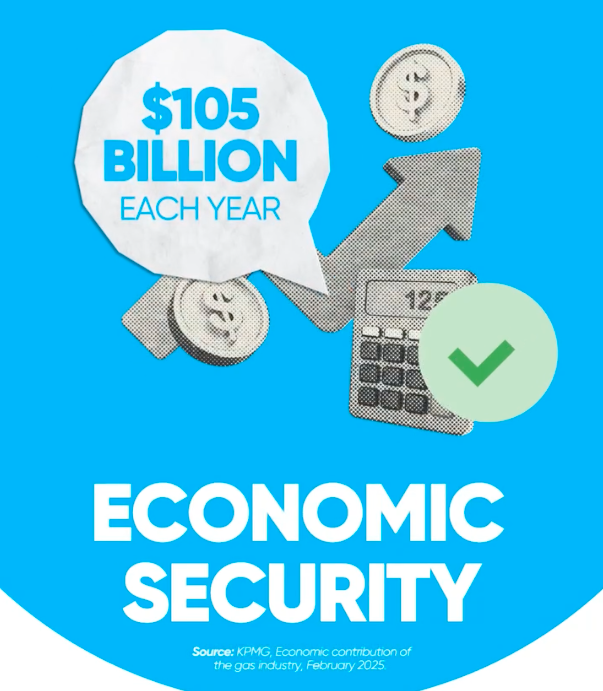
The ads sell two headline figures, 215,000 jobs and a $105 billion annual contribution to the economy, along with state-by-state versions of those numbers. Together, these ads have been shown on Facebook and Instagram at least 53 million times. The $105 billion national figure alone accounts for nearly three-quarters of the spend: at least $239,000 across 183 ad postings, shown at least 40 million times.
Are people buying it?
Where comments have been left on, the vast majority of commenters were skeptical. This included questioning the figures and referring to the ads as “spin”, “satire”, and “propaganda”.








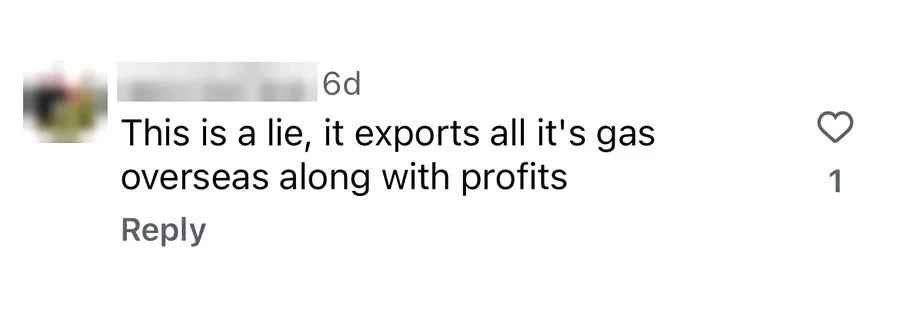
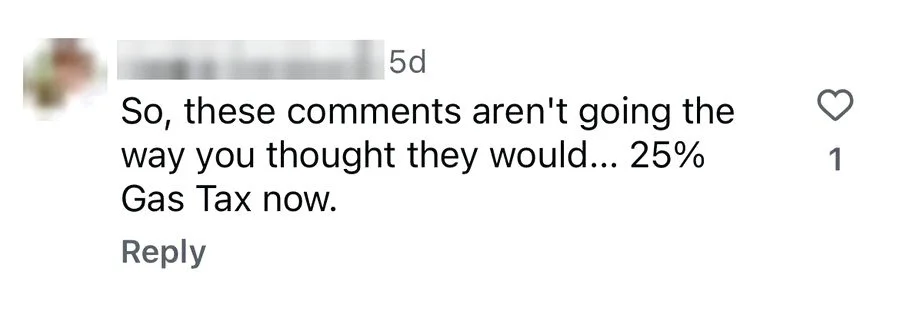


Screenshots of Top Comments under one AEP Meta ad with graphic stating: “Australia’s natural gas contributes $105 billion each year to our economy”
A scenario that doesn’t describe the real world
To generate the jobs and economy headline, KPMG modelled a “sudden shutdown scenario” in which gas production stops entirely. It then measured how much smaller the economy would have been in 2021-22. That gap is $105 billion.
In KPMG's own words:
"The shut-down is sudden and unexpected so that businesses cannot adjust their capacity and gas users have limited options for replacing gas with an alternative fuels; Businesses and households that use gas are able to replace domestic gas with imported gas at approximately the same cost; and Real wages are assumed to be sticky so do not adjust down to absorb the shock."
In other words:
No household installs a heat pump or an induction cooktop.
No manufacturer electrifies a process or improves efficiency.
No displaced worker finds another job within the modelled year
No renewable or electrification investment flows into the gap.
KPMG itself acknowledges that “the assumptions in this scenario relating to the ability of the economy to adjust mean that the impacts estimated are less applicable to the longer term."
Yet AEP uses these figures in the present tense, despite being a hypothetical model based on 2021-22.
Disclaim Away
The report is also heavily caveated. KPMG states that:
"no opinions or conclusions intended to convey assurance have been expressed"
"We have not sought to independently verify those sources unless otherwise noted within the work."
"This work is solely for the Australian Energy Producers' information and is not to be used for any other purpose or distributed to any other party without KPMG's prior written consent."
That last clause sits awkwardly beside a paid social media campaign. We asked KPMG whether they had provided written consent for Australian Energy Producers to publish the report and use its figures in paid advertising. KPMG did not respond.
Whose money?
Take the $105 billion at face value for a moment, and ask a different question: where does it go?
$19 billion of it is the modelled indirect component – activity attributed to other industries.
The remaining $85 billion is the direct figure, which KPMG splits into two parts:
Of every 100 cents of direct contribution, 7 are payments to workers and 93 are gross operating surplus.
7 cents
Payments to workers — $6 billion
93 cents
Gross operating surplus — $79 billion
KPMG doesn’t break that $79 billion down any further. We’re not told what share of that leaves the country through foreign owners and lenders, or written off against the cost of building the infrastructure. Both are likely substantial in an industry that is overwhelmingly foreign owned and among the most capital-intensive in the country. Seven percent reaches an Australian pay packet. That’s the only part we can follow.
“Out of scope”
KPMG's report counts the money gas generates and excludes what it costs. Climate change and environmental impacts are, in its words, "beyond the scope of this report". So there is no line item for polluted air near gas fields, none for the asthma linked to gas stoves in Australian homes (an estimated 12.3% of the childhood asthma burden [Knibbs et al., 2018]), and none for the emissions that drive heat, fire and flood. A ledger with only one column will always show a profit.
KPMG says it will "support our clients' and Australia's transition to net zero". Yet a report that excludes the costs of gas is a questionable thing for the firm to be associated with, and each ad that cites it gives the public a reason to wonder whether those commitments are more than greenwashing.
“Public trust depends on being able to rely on professional advice. Every time a firm's name is attached to modelling that is then stripped of its assumptions and deployed as a campaign slogan, that trust erodes.”
— Claire Snyder, Executive Director, Climate Integrity
As part of our analysis of the KPMG report commissioned by Australian Energy Producers, we posed the following questions to each company, to provide an opportunity to respond to our findings.
Both KPMG and AEP declined to provide a response to our questions.
-
On the citation
1. The advertisements cite the report as "February 2025". The published report available on the AEP’s website is dated 18 December 2024. Has KPMG produced a February 2025 edition, update or revision, or any subsequent report on this subject? If no such version exists, does KPMG consider "February 2025" an accurate citation for the December 2024 report?
On how the figures are characterised
2. Australian Energy Producers' advertising says the gas industry "contributes more than $105 billion each year" to the national economy, with regional examples such as Western Australia's $35 billion and 73,000 jobs, attributed to KPMG. In your December 2024 report, these figures appear to be modelled losses from replacing domestic gas with imports. Does KPMG consider this use accurate?
On consent and reliance:
3. The report states it "is not to be used for any other purpose or distributed to any other party without KPMG's prior written consent". Did KPMG provide written consent for Australian Energy Producers to publish the report and use its figures in paid advertising? If so, does KPMG review the advertising copy before publication?
4. The report states that KPMG "undertakes no responsibility arising in any way from reliance placed by a third party on this work". It is nonetheless cited in Australian Energy Producers' submissions to Commonwealth processes, including its submissions to the Gas Market Review (here) Productivity Commission (here). Does KPMG have a view on its use as evidence in government policy processes?
On scope and KPMG's climate position:
5. Section 1.1 states that it is "beyond the scope of this report to analyse climate change and/or environmental impacts". Was that exclusion KPMG's professional judgement, or a limitation set by Australian Energy Producers in the 11 June 2024 engagement letter?
-
1. AEP's advertising states the gas industry "contributes more than $105 billion each year" to the national economy, including regional examples such as Western Australia's $35 billion and 73,000 jobs, attributed to KPMG. In the KPMG report cited (linked here), that figure is the modelled reduction in GDP in 2021-22 under a scenario in which Australia's domestic gas industry ceases operations and gas users switch to imported gas. Does AEP consider it accurate to present that figure as an ongoing annual contribution?
2. The KPMG report states it "is not to be used for any other purpose or distributed to any other party without KPMG's prior written consent". Did AEP seek permission from KPMG to publish the report and cite it in paid advertising, and in submissions to Commonwealth processes including AEP's 15 August 2025 submission to the Gas Market Review and its 15 September 2025 submission to the Productivity Commission's Five Pillars of Productivity inquiries?
3. AEP's earlier advertising, including the billboard near Canberra Airport, cited the report as December 2024. Current advertising and AEP's submissions cite it as 2025 or February 2025. Why did the citation change?
Sources
[1] Analysis of AEP’s Meta Ads spending and reach produced with support from OPPO (oppotools.io), using publicly available information from Meta Ad Library (facebook.com/ads/library), Australian Energy Producers, page ID 471390022952217.
